


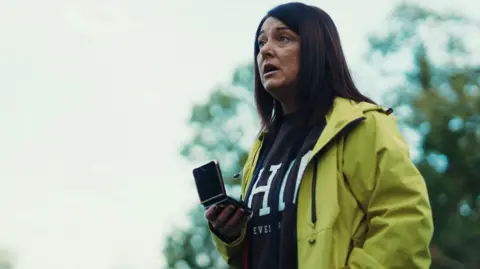
While filming an interview near a public park in Falkirk, a woman approached.
May I inquire why you’re allowing these people to use this public space?” she asked while recording the exchange on her smartphone.
The individual we were discussing with for our investigation was living in a local temporary housing, where heated protests had been taking place since the summer.
The individual claimed that men from the hotel had been following local minors, and requested that we relocate our interview elsewhere.
Suddenly, a collection of residents who we were unaware of playing football nearby came over the slope.
She informed me it was my fault they were there and if “anything happens here, it’s on you.”
The individual uploaded her footage to the internet. It was seen numerous of times after being circulated by conservative influencers.
She was hailed as a champion for protecting women and children.
I was overwhelmed with abuse and warned that I should leave Falkirk.
I do not think that my discussion with this person, who later decided against its use, posed any risk.
But this encounter, and its consequences, gave me likely the clearest insight yet into the anxiety some within the town – and beyond – have about asylum seekers in their communities.
Local Concerns and Demonstrations
There are about over six thousand people requesting protection in the region, many of whom arrived via vessels across the waterway.
About a 25% stay in temporary accommodations while the administration evaluates whether to give them sanctuary.
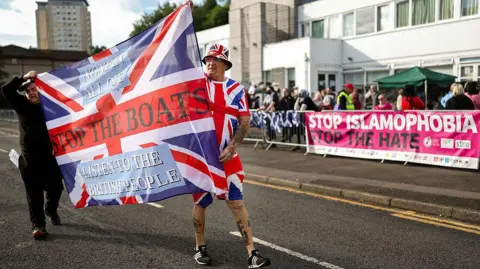
We’ve spent the last few months documenting at protests against the facilities around the region.
In the town, there are more than 11,000 people on the waiting list, awaiting new homes. There is anger at a view that these people – and it is only men in the Cladhan Hotel – have skipped the line.
Individuals are not usually permitted to work while their requests are being evaluated and get an stipend of £1.42 a day to subsist on. With provided food, housing and no bills to pay, it angers of several.
“They’re getting entertainment, they have warmth, they’re getting clothing, they’re getting communication tools, they have free healthcare and if you think that’s right in our society right now, I don’t.”
Smartphones are not provided by the government but are commonly donated to individuals by organizations who support them.
Protection Concerns and Local Conflict
The individuals in the Cladhan originate from a variety of nations, including the Middle East, Africa and another region, and all claim they need protection from danger.
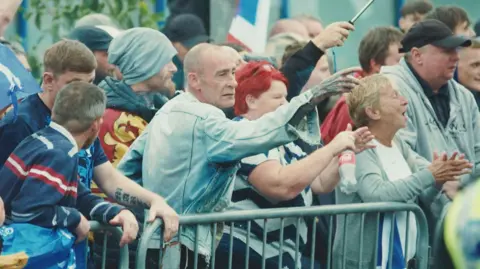
Periodically we could see them watching from behind covered windows, as shouts of “Return them! Deport them!” resounded through the streets.
The Cladhan was formerly a popular location for celebrations, special occasions and functions.
No warning was given or discussion arranged with the residents that up to numerous refugees were going to be housed here in recent years.
“There exists a feeling that a matter is being imposed on them from above by individuals who are unaware and uninterested what the impact is going to be.”
All the financial outlays of accommodating individuals in temporary facilities, about 2.1 billion pounds a year across the UK, are met by the administration.
The local authority head said no asylum seeker was given special treatment over anyone else.
But it’s not just pressure on resources which has got residents out on the streets. There is concern, too.
Ex hotel occupant a person, from a foreign country, was imprisoned in recent months for the rape of a 15-year-old local female.
“It devastated me to know that that individual’s life was destroyed.”
“We ought not be moving around in fear,” she added.
In recent times, the year of Nikzad’s offense, there were numerous cases of rape or attempted rape in the area.
Police Scotland states it does not hold data detailing whether perpetrators are asylum seekers or not.
From publications, it appears a single case was committed by an asylum seeker that time – by Nikzad.
“Scottish men do this too, but the reality is that the arrivals are still coming. They [the asylum seekers] have a different belief.”


